
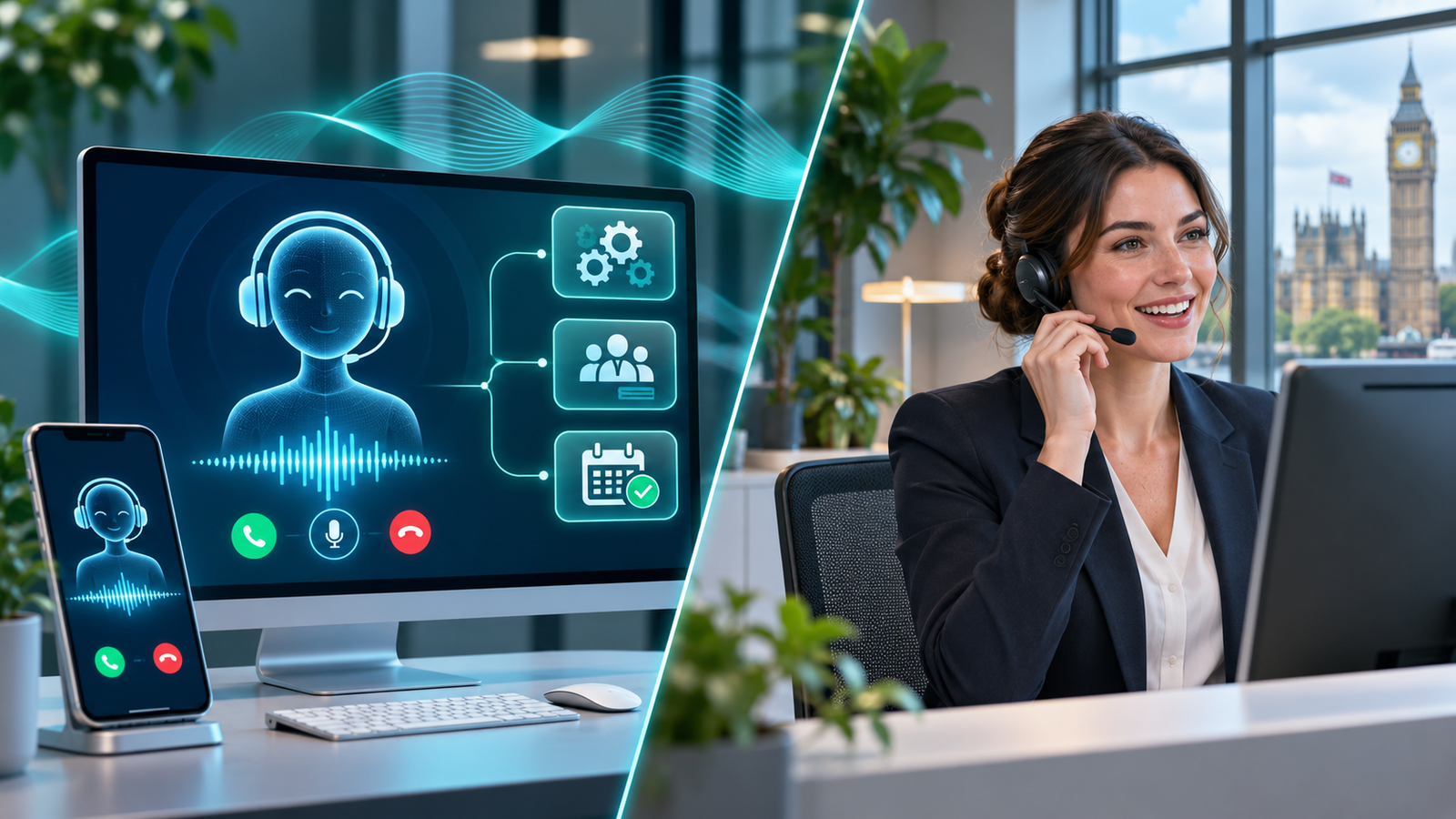
It's 6:45 pm on a Friday. A homeowner calls a plumbing company about a leaking pipe, but the engineers are finishing their last jobs and the office has closed.
The call goes to voicemail. The customer hangs up and tries another company.
For a busy UK service business, situations like this raise an important question: should you hire another receptionist, outsource your calls or use an AI receptionist to handle enquiries when your team is unavailable?
GoHighLevel Voice AI offers another option. It can answer incoming calls, respond to business-specific questions, collect customer details and book appointments through connected calendars.
But does that make it a better investment than a human receptionist?
Not necessarily.
The right decision depends on how many calls you receive, when customers contact you, how complicated those conversations are and what you need your receptionist to achieve.
This guide compares GoHighLevel Voice AI with in-house receptionists and outsourced telephone answering services, including UK costs, practical capabilities, limitations and the circumstances where combining AI with human support makes more sense.
GoHighLevel Voice AI vs Human Receptionist: Which Is Better?
GoHighLevel Voice AI is often a better fit for routine enquiries, appointment scheduling and out-of-hours call coverage. A human receptionist is generally better equipped to handle complex requests, sensitive conversations, complaints and situations requiring professional judgement.
For many UK businesses, the strongest solution is neither AI-only nor human-only. A hybrid arrangement can use AI to handle straightforward calls and direct more complicated conversations to a person.
The best choice depends on the actual cost per useful outcome, not simply the number of calls answered.
What Is a GoHighLevel AI Receptionist?
A GoHighLevel AI receptionist is a Voice AI agent configured to speak with callers and perform approved tasks on behalf of a business.
Unlike traditional voicemail or a recorded phone menu, Voice AI can respond to what someone says during a live conversation.
For example, a caller might ask:
"Do you offer boiler servicing in Manchester, and can somebody come out next Tuesday?"
A properly configured agent can consult approved business information, collect relevant details and, where supported and appropriately configured, check appointment availability.
It can also update the caller's CRM record or trigger a follow-up process.
What can GoHighLevel Voice AI do?
Depending on the agent's configuration, HighLevel supports capabilities including:
- Answering incoming calls.
- Responding to frequently asked questions using a business Knowledge Base.
- Collecting names and contact information.
- Asking lead qualification questions.
- Booking appointments into connected calendars.
- Updating GoHighLevel contact fields.
- Triggering workflows and follow-up actions.
- Sending supported SMS messages.
- Transferring calls to human representatives.
- Passing conversations between specialised Voice AI agents.
These capabilities make Voice AI particularly relevant to service businesses with predictable first-line enquiries.
However, an AI agent is only as dependable as its instructions, approved information, integrations and escalation rules.
If the Knowledge Base contains incorrect opening hours, the agent may provide incorrect information. If the calendar is configured improperly, the booking process may fail.
The technology doesn't eliminate the need for operational oversight.
What Can a Human Receptionist Do Better Than Voice AI?
A skilled receptionist does more than answer the telephone.
They interpret situations, recognise urgency, handle exceptions and often help customers feel understood.
Consider a patient who calls an aesthetics clinic because they're worried about a reaction after treatment.
A human receptionist can recognise that the enquiry needs immediate attention from an appropriately qualified member of staff.
An AI agent can be instructed to identify certain warning signs and escalate, but it shouldn't be relied upon to make clinical judgements.
Similar limitations apply to emotionally difficult conversations, unusual complaints and complex commercial negotiations.
A human receptionist is often better positioned to:
Respond with judgement. People can interpret unusual circumstances and adapt when standard procedures don't fit.
Handle sensitive situations. Distressed callers may need reassurance and an appropriate personal response.
Build relationships. Familiar staff members can recognise returning customers and understand their history.
Resolve ambiguity. Human staff may be better at clarifying complicated or contradictory requests.
Manage exceptions. They can consult colleagues and make authorised decisions when established rules don't cover the situation.
Humans also make mistakes, experience workload pressure and cannot provide continuous coverage without sufficient staffing.
The point isn't that one approach is flawless. It's that they have different strengths.
GoHighLevel Voice AI vs Human Receptionist: Feature Comparison
| Capability | GoHighLevel Voice AI | Human receptionist |
|---|---|---|
| Out-of-hours availability | Can provide extended or 24-hour coverage when configured | Depends on scheduled staffing |
| Repetitive FAQs | Well suited to approved, predictable questions | Capable, but time-consuming |
| Appointment booking | Supported through configured calendars | Can handle straightforward and exceptional bookings |
| Lead qualification | Can apply defined questions and criteria | Can interpret more nuanced situations |
| CRM updates | Can update supported fields automatically | Requires manual entry or integrations |
| Human empathy | Simulates conversational responses but lacks human judgement | Stronger potential for genuine personal support |
| Complex complaints | Should escalate | Usually better suited |
| Multiple enquiries | Can scale subject to system and account limits | Requires sufficient staff capacity |
| Call transfers | Configurable | Can transfer or refer directly |
| UK accents | Performance depends on audio quality and speech recognition | Also varies by individual |
| Training | Requires prompts, approved information and testing | Requires onboarding and supervision |
| Consistency | Can follow defined instructions repeatedly | May vary across employees |
| Error handling | Depends on recognised scenarios and fallback rules | Greater flexibility with unusual situations |
| Cost structure | Setup, subscription, usage and possible support charges | Employment, outsourcing or staffing costs |
| Technology dependency | Requires functioning telephony and AI services | Requires a working phone system but is less dependent on AI infrastructure |
A business that mainly receives opening-hours enquiries may benefit from AI.
A business where most calls involve complex advice or sensitive decisions may gain more from skilled human staff.
How Much Does GoHighLevel Voice AI Cost in the UK?
The cost of a GoHighLevel AI receptionist is not simply a single monthly subscription.
There are several separate components, and they should be considered individually.
1. Professional Voice AI implementation
GHL Experts UK publishes Voice AI implementation from £2,995 excluding VAT.
The service is intended for businesses needing a configured agent, business-specific information, booking and CRM integration, escalation rules and testing.
The published typical implementation timeframe is approximately three to four weeks, depending on the scope.
The £2,995 figure is a starting implementation fee, not a universal package price or recurring monthly subscription.
2. GoHighLevel platform subscription
The business also needs an appropriate GoHighLevel subscription or access through an agency-managed account.
HighLevel publishes agency plans in US dollars, with pricing depending on the account arrangement.
If you already use GoHighLevel, the relevant question is whether Voice AI requires additional spending beyond your existing setup.
3. Voice AI processing charges
HighLevel offers pay-per-use Voice AI and eligible AI Employee subscription plans.
Under its documented component-based pricing, the Voice Engine costs $0.045 per minute.
Text-to-speech charges vary by provider.
For example, a supported OpenAI TTS option costs $0.015 per minute, while other providers and voice models may cost more.
AI model usage can add token-based charges.
HighLevel also offers speech-to-speech configurations with different per-minute pricing, so the component-based formula must not be applied indiscriminately to every model.
4. AI Employee plans
HighLevel's November 2026 pricing documentation lists the following sub-account AI Employee options:
| Plan | Published subscription | Voice AI allowance |
|---|---|---|
| Starter | $20/month | Voice AI not included |
| Growth | $50/month | 100 Voice AI minutes/month |
| Unlimited | $97/month | Unlimited Voice AI usage, subject to fair use |
| Starter availability is restricted to eligible agency arrangements. Growth and Unlimited availability is also subject to the applicable account requirements. | When an included allowance is exhausted, usage may pause unless extra usage is enabled. | An Unlimited AI subscription should not be interpreted as unlimited telephone connectivity without additional charges. |
5. Telephone charges
Phone numbers, inbound call minutes, transfers and related telephony services can introduce additional charges.
These are separate from the Voice AI engine itself.
The relevant rates depend on the phone system, destination and account configuration.
6. Ongoing optimisation
After launch, businesses may need Knowledge Base updates, prompt adjustments, conversation reviews and new call handling rules.
GHL Experts UK publishes optional AI optimisation services from £395 per month excluding VAT.
Whether you need ongoing external support depends on the complexity of the system and your team's ability to maintain it.
AI receptionist cost breakdown
| Cost | Type | What to budget for |
|---|---|---|
| Professional implementation | One-off | From £2,995 + VAT through GHL Experts UK |
| GoHighLevel subscription | Recurring | Depends on account arrangement |
| AI Employee subscription | Optional recurring | Depends on selected eligible plan |
| Voice AI processing | Usage-based | Depends on engine or speech-to-speech configuration |
| Text-to-speech | Usage-based where applicable | Depends on provider and voice |
| AI model | Usage-based where applicable | Depends on model and token consumption |
| Phone system | Usage-based or recurring | Numbers, calls, transfers and other telephony |
| Optimisation | Optional recurring | From £395/month + VAT through GHL Experts UK |
The correct total is the combination of the components applicable to your chosen setup—not every line added together automatically.
Example: 300 calls per month
Consider a hypothetical UK business that receives:
- 300 AI-handled calls per month.
- An average call duration of three minutes.
- A total of 900 AI call minutes.
If it uses HighLevel's documented component-based Voice Engine and a $0.015-per-minute OpenAI TTS option, the calculation is:
| Component | Calculation | Illustrative monthly cost |
|---|---|---|
| Voice Engine | 900 × $0.045 | $40.50 |
| Text-to-speech | 900 × $0.015 | $13.50 |
| Combined subtotal | $54.00 | |
| AI model processing | Depends on tokens and model | Additional |
| Telephone charges | Depends on phone usage | Additional |
| Platform or AI subscription | Depends on chosen arrangement | Additional |
| The $54 figure is not the complete monthly AI receptionist cost. | It represents only the two documented usage components shown in the example, before model, phone and relevant subscription charges. | It also doesn't include implementation or optional support. |
A business using a speech-to-speech model would need a different calculation.
Always confirm current HighLevel pricing and the expected call mix before quoting a final cost.
How Much Does a Human Receptionist Cost in the UK?
Human reception costs depend on whether you employ somebody or use a third-party telephone answering service.
These are quite different arrangements.
In-house receptionist
The UK government's National Careers Service publishes a broad receptionist salary guide of approximately £21,000 to £25,000 annually, although actual current pay must meet statutory minimum wage rules and can be higher depending on experience and location.
From April 2026, the National Living Wage for workers aged 21 or over is £12.71 per hour.
For someone working 37.5 paid hours per week throughout a 52-week year, that produces an illustrative gross annual wage of approximately £24,785.
That is only the salary component.
Depending on the employer's circumstances, additional costs may include employer National Insurance, workplace pension contributions, recruitment, equipment, management, training and holiday or sickness cover.
Using standard 2026–27 assumptions, before relevant reliefs or allowances, an illustrative calculation would be:
| Component | Illustrative annual cost |
|---|---|
| Gross wages at £12.71/hour | £24,784.50 |
| Employer NI at standard 15% above £5,000 threshold | £2,967.68 |
| Minimum employer pension based on qualifying earnings | £556.34 |
| Illustrative subtotal | £28,308.52 |
| This is approximately £2,359 per month, before recruitment, equipment, supervision and cover. | Actual payroll costs will vary. For example, Employment Allowance, pension scheme rules and employee circumstances may affect the calculation. |
| The example is not an average UK receptionist salary or a quotation for hiring. | A receptionist also contributes work beyond telephone answering, such as welcoming visitors, coordinating staff and handling administrative tasks. Those benefits should be included in the decision. |
Part-time receptionist
A part-time employee may suit a business with predictable busy hours.
The cost can be lower than full-time employment, but evenings, weekends and absences may still leave gaps.
Outsourced human answering service
A UK telephone answering provider employs people to answer calls on behalf of several businesses.
Plans may charge a monthly fee, per call, per minute or through bundled allowances.
For example, UK provider ReceptionHQ advertises services from £15 per month, with higher charges depending on the plan, volume and handling requirements.
Its more involved virtual assistant service publishes packages such as £99 per month for 100 included minutes, plus VAT, with excess usage billed separately.
These figures demonstrate why comparing headline monthly fees alone can be misleading.
A simple message-taking plan and a service that books appointments or updates CRM records don't provide the same scope of work.
For low call volumes, outsourced human answering may be a sensible alternative to both employment and a custom AI implementation.
AI vs Human Receptionist: Which Is More Cost-Effective?
A fair comparison needs to consider four arrangements.
| Factor | GoHighLevel Voice AI | In-house receptionist | Outsourced human answering | Hybrid model |
|---|---|---|---|---|
| One-off cost | Potentially significant setup | Recruitment and onboarding | Often modest setup | AI setup plus routing configuration |
| Monthly cost | Subscription and variable usage | Salary and employment costs | Package and usage fees | Combination of applicable costs |
| Out-of-hours service | Possible when configured | Requires shift coverage | Depends on plan | AI can provide extended coverage |
| Complex conversations | Limited | Strongest fit | Depends on service level | Escalated to people |
| CRM integration | Native and configured actions | Manual or connected tools | Provider-dependent | Connected handover workflow |
| Appointment booking | Available with configured calendars | Flexible | Package-dependent | Can use either channel |
| Maintenance | Knowledge Base and technical testing | Ongoing training and management | Provider management | Both operational processes |
| Best suited to | Structured, repetitive calls | High-touch and complex reception | Lower-volume human answering | Mixed call types and extended hours |
For an established clinic with a busy reception desk, replacing staff may make little sense.
For a trades business with no office team and frequent evening enquiries, AI may fill an important coverage gap.
For a sole trader receiving only ten missed calls per month, a modest human answering package could be more economical than investing in a customised AI solution.
The right measure is not the lowest advertised monthly price. It's the cost of delivering an acceptable customer experience and useful business outcomes.
Can GoHighLevel Voice AI Book Appointments Automatically?
Yes. GoHighLevel Voice AI supports live appointment booking through configured HighLevel calendars.
A caller can request a consultation, discuss suitable times and provide information required to complete a booking.
HighLevel supports both single-calendar booking and routing between multiple eligible calendars based on the caller's intent.
For example, a clinic might maintain separate calendars for initial consultations and follow-up visits.
With suitable configuration, the AI can select an appropriate calendar and offer available appointment slots.
What needs to be configured?
Reliable booking depends on:
- Correct calendar availability.
- Appointment durations.
- Booking buffers and minimum notice.
- Relevant staff or resource availability.
- Connected external calendars where applicable.
- Appropriate calendar descriptions.
- Required customer information.
- Confirmations and follow-up processes.
AI working hours and appointment calendar availability are separate settings.
An AI receptionist could answer calls at midnight while only offering appointment slots during the clinic's actual opening hours.
What can go wrong?
Problems can arise if a calendar is out of sync, availability is incorrect or several similar calendars have confusing descriptions.
The caller may also provide incomplete details or request an unsupported type of appointment.
HighLevel's current Voice AI booking support includes Single Calendar and Multiple Calendars. Its separate Services feature is not currently available in the Voice AI appointment-booking setup.
The agent should be tested against ambiguous requests, unavailable times, cancellations and situations where a suitable appointment cannot be offered.
What Happens When a Caller Wants to Speak to a Human?
A business shouldn't force every caller to continue talking to AI.
GoHighLevel supports Call Transfer, allowing a Voice AI agent to route a caller to a human representative using a configured telephone number.
This is especially useful when:
- The caller explicitly asks for a person.
- The enquiry becomes too complicated.
- A customer raises a complaint.
- A sensitive topic requires human judgement.
- A valuable sales lead needs specialist assistance.
- The agent cannot provide a reliable answer.
Call Transfer vs Agent Transfer
The two HighLevel features sound similar but serve different purposes.
Call Transfer connects the caller to a human representative or another phone destination.
Agent Transfer moves the live conversation between specialised Voice AI agents.
For example, a general AI receptionist might transfer a booking question to a separate AI booking specialist.
But if the customer asks for a manager, Call Transfer is the relevant human handover mechanism.
What if nobody is available?
Every AI receptionist should have a fallback process.
Depending on the business, the agent might record a callback request, update the CRM and notify the appropriate team.
It should not repeatedly promise a live transfer if nobody is available.
Nor should it imply that someone has been contacted when the transfer failed.
A reliable handover process requires clear rules about who receives the enquiry, how it is recorded and what happens next.
Which UK Businesses Benefit Most from GoHighLevel Voice AI?
Voice AI is generally most suitable when routine enquiries are common and timely response matters.
The exact benefit depends on the industry's call patterns.
Trades and home services
Plumbers, electricians, heating engineers and roofers often receive calls while working on-site.
A well-configured AI receptionist may answer general service questions, collect postcode and job details, and arrange suitable callbacks or appointments.
This makes it particularly relevant to businesses where staff cannot consistently answer incoming enquiries.
However, dangerous situations should be escalated or directed towards appropriate emergency services rather than handled through automated technical advice.
For businesses already using GoHighLevel, a connected CRM setup for trades and home services can help organise lead follow-up after calls are captured.
Medical aesthetics and wellness clinics
Clinics frequently receive questions about opening hours, consultation availability, general service information and appointments.
Voice AI may assist with these routine enquiries.
However, treatment complications, sensitive medical information, clinical suitability and urgent patient concerns require appropriate human or clinical handling.
The agent should have strict boundaries and should not present itself as a qualified clinician.
A properly designed GoHighLevel solution for medical aesthetics clinics needs to account for these operational distinctions.
Estate agents
An AI receptionist may capture property enquiries, record viewing preferences and request appropriate follow-up.
Human agents remain important for negotiations, unusual circumstances and complex property transactions.
Recruitment agencies
Voice AI may be useful for basic interview availability, office enquiries and appointment requests.
Decisions about candidate suitability, employment rights or sensitive recruitment matters shouldn't be delegated casually to an automated agent.
Fitness and wellness businesses
Gyms, studios and personal trainers may use AI to answer routine membership questions, explain class availability or arrange introductory consultations.
Personalised coaching discussions and unusual customer needs may still be better handled by staff.
Marketing agencies
Agencies may implement Voice AI as a managed service for clients that receive repetitive enquiries.
Here, the challenge isn't simply deploying an agent once. It also includes maintaining separate Knowledge Bases, calendars, escalation processes and reporting for each client.
When Is a Human Receptionist the Better Choice?
There are circumstances where human reception provides greater value than automated answering.
Consider a premium consultancy where almost every call involves an important commercial decision.
The caller may need reassurance, nuanced advice or a detailed discussion with someone who understands the business.
Adding an AI layer could introduce unnecessary friction.
A human-first approach may also be more appropriate where the business handles vulnerable customers, sensitive health matters, high-stakes complaints or professional advice.
Low-volume businesses should consider costs carefully, too.
If only a handful of straightforward calls are missed every month, the full cost of implementation, maintenance and oversight may not be justified.
The best choice is the one that meets the business's real needs, not the one using the newest technology.
Is a Hybrid AI and Human Receptionist Model Better?
For many organisations, a hybrid model is worth evaluating first.
It allows the business to retain human expertise while expanding the coverage available for routine enquiries.
A possible call flow is:
During normal office hours: Human receptionist answers.
When staff are busy: Voice AI handles suitable overflow enquiries.
Outside office hours: AI answers routine calls and captures booking requests.
When the caller needs specialist help: The call transfers to a person or creates an appropriate callback task.
Example: A UK plumbing business
The following scenario is illustrative.
A customer calls at 7 pm and asks:
"Can somebody come and look at my boiler tomorrow?"
The AI identifies that the caller wants an appointment.
It asks for the caller's postcode, contact details and a brief description of the issue.
If an appropriate booking calendar is available, it offers suitable times.
The customer then explains that they can smell gas.
That changes the nature of the conversation.
Instead of continuing with ordinary appointment scheduling, the agent should follow a pre-approved safety escalation procedure, directing the caller to the relevant emergency gas service and avoiding speculative repair instructions.
For a UK mains gas emergency, the established emergency contact is the National Gas Emergency Service on 0800 111 999.
This illustrates why a Voice AI implementation needs explicit boundaries, not simply an ability to book appointments.
Why the hybrid approach can work
The business doesn't need to use a person for every repetitive question.
But it also doesn't expect the AI to manage every exceptional situation.
A hybrid model can retain important human interaction while providing additional response coverage.
The quality of the result depends on correct routing, appropriate staffing and a reliable CRM handover.
How to Implement GoHighLevel Voice AI for a UK Business
A successful setup starts with the business process, not the voice selection.
Step 1: Review your existing calls
Identify when customers phone, what they ask and which calls require human attention.
Review a representative sample of enquiries where appropriate and lawful.
Look for patterns rather than relying on assumptions.
Step 2: Define what AI is allowed to handle
Choose a limited initial scope.
For example, the agent might handle opening hours, general service questions, contact capture and introductory bookings.
Keep sensitive or complicated situations outside that scope.
Step 3: Build an approved Knowledge Base
Use accurate information about services, opening hours, location, booking policies and general pricing.
Avoid inventing answers when information is missing.
Set a clear process for keeping the Knowledge Base current.
Step 4: Configure the agent
Within the appropriate HighLevel sub-account, open AI Agents → Voice AI and create or select the agent.
Review its identity, conversational instructions, voice settings, availability and relevant call configuration.
Step 5: Connect actions
HighLevel supports actions including Appointment Booking, Update Contact Field, Trigger a Workflow, Call Transfer and supported external requests.
Only enable actions the business actually needs.
For example, follow-up notifications can be connected through GoHighLevel workflow automation so an authorised team member receives relevant enquiry details.
Step 6: Configure handovers
Define the circumstances requiring a human.
Specify a suitable transfer destination and fallback process.
Step 7: Test realistic conversations
Test the agent with straightforward and difficult questions.
Include background noise, incomplete details, interruptions, UK accents, unavailable appointment slots and callers who explicitly request human assistance.
Step 8: Launch gradually
Start with a manageable group of calls or a limited coverage window.
Review calls, transcripts and outcomes where lawful and appropriate.
Refine the configuration before expanding coverage.
Go-live readiness checklist
- Business information is accurate.
- Agent instructions and boundaries are approved.
- Calendars and booking rules are tested.
- Contact information reaches the CRM correctly.
- Follow-up notifications work.
- Human handover has been tested.
- A fallback process exists.
- Caller disclosure and privacy information are appropriate.
- Call retention and access permissions are configured.
- Costs and usage can be monitored.
- Staff know how to respond to escalated enquiries.
The quality of the setup matters at least as much as the voice technology.
Common Problems with AI Receptionists
Voice AI systems can fail in ways that are different from traditional reception.
| Problem | Possible cause | What to do |
|---|---|---|
| Incorrect service information | Outdated or incomplete Knowledge Base | Review approved information and retest |
| Wrong appointment slot | Calendar configuration issue | Check availability, buffers and sync |
| Misheard caller details | Background noise or speech recognition | Confirm critical details before saving |
| Unnatural pauses | Processing latency or overly complex configuration | Review model, prompts and call settings |
| Incorrect qualification | Ambiguous decision rules | Simplify and test qualification conditions |
| Failed human transfer | Routing or destination issue | Test numbers and fallback behaviour |
| Missing CRM notes | Incomplete field mapping or actions | Inspect post-call actions and records |
| Unexpected charges | Longer calls, premium models or phone usage | Review usage and billing configuration |
| Caller frustration | AI repeats itself or cannot escalate | Set clearer handover conditions |
| Service interruption | Telephony or AI provider issue | Maintain a practical contingency route |
No system is error-free.
Businesses should evaluate actual call quality and customer outcomes rather than relying exclusively on successful demonstration calls.
UK GDPR, Call Recording and AI Transparency
UK businesses implementing an AI receptionist should review how caller information is collected, stored and used.
A Voice AI call may involve names, telephone numbers, appointment details, transcripts, recordings and other personal data.
Under the UK GDPR, relevant processing requires an appropriate lawful basis, transparent privacy information and suitable safeguards.
Tell callers what they need to know
A clear introduction explaining that the caller is speaking with an AI assistant is sensible.
If calls are recorded, callers should receive appropriate information about the recording and its purpose.
A business must also consider how people can access its full privacy information.
Review recording and retention
Not every business needs to retain every recording indefinitely.
Define why recordings or transcripts are necessary, who can access them and how long they should be retained.
Where possible, minimise the personal information collected.
Handle sensitive information carefully
Medical clinics and other organisations handling potentially sensitive data should establish strict controls.
The AI agent should avoid requesting unnecessary information and should escalate matters requiring professional judgement.
Inbound calls and outbound marketing are different
An inbound customer service call is not automatically subject to the same PECR rules as an unsolicited outbound marketing call.
The ICO sets specific requirements for automated marketing calls involving recorded messages, while other direct marketing call types have their own rules.
The exact treatment of a conversational outbound AI system may require additional assessment.
Businesses should not assume that configuring an AI receptionist gives them permission to make automated marketing calls.
For complicated or regulated deployments, obtain appropriate UK data protection and sector-specific advice.
How to Calculate Whether an AI Receptionist Is Worth It
The real value of a receptionist comes from useful customer outcomes.
Start with your current call data.
How many calls do you receive?
How many are missed?
How many are genuine enquiries?
How many result in appointments?
How many of those appointments lead to paying customers?
Then compare the costs of each proposed answering arrangement.
Useful metrics
Cost per handled call
Relevant monthly answering costs ÷ calls handled.
Cost per qualified enquiry
Relevant monthly answering costs ÷ enquiries meeting agreed qualification criteria.
Cost per booked appointment
Relevant monthly answering costs ÷ valid appointments booked.
These metrics help compare operational effectiveness.
They don't measure full customer acquisition cost unless advertising and other acquisition expenses are also included.
Hypothetical ROI example
Imagine a UK home services business receiving 300 calls each month.
It estimates that 60 calls currently go unanswered.
Of those missed calls, suppose 20 are genuine service enquiries.
After introducing a suitable answering arrangement, assume 12 of those enquiries become valid appointments and three ultimately become customers.
If the average contribution from each additional customer after direct job costs were £250, the hypothetical contribution would be:
3 customers × £250 = £750.
That isn't automatically £750 in additional profit.
The business must deduct the relevant incremental cost of its answering solution, including operational charges and a reasonable allocation of any implementation investment.
It must also establish that the customers were genuinely incremental rather than people who would have booked through another channel anyway.
Compare the options over a meaningful period
A useful assessment should include at least:
- Current missed-call baseline.
- Answering coverage.
- Qualified enquiries captured.
- Appointments attended.
- Customers acquired.
- Total operating costs.
- Implementation cost spread over a reasonable evaluation period.
- Customer feedback and complaints.
AI might appear inexpensive on a per-minute basis but still be a poor investment if it delivers unsuitable enquiries.
Conversely, a human answering service might cost more per call yet deliver better results for complicated enquiries.
The decision should follow the evidence.
GoHighLevel Voice AI vs Human Receptionist: Final Decision Framework
| Your business situation | Option worth considering first | Why |
|---|---|---|
| Frequent routine questions | Voice AI | Predictable first-line answers |
| Calls regularly arrive after hours | Voice AI or outsourced answering | Additional coverage |
| Sensitive or emotional conversations | Human receptionist | Professional judgement and empathy |
| Low call volume | Human answering service | May avoid substantial initial setup cost |
| High appointment volume | Voice AI or hybrid | Structured scheduling |
| Existing reception team overwhelmed | Hybrid | Overflow support without removing staff |
| Complex high-value sales calls | Human-first | Nuanced conversation and relationship-building |
| Multi-location enquiry handling | Configured AI or hybrid | Structured routing and CRM integration |
| Unclear business processes | Fix the process before adding AI | Automation may magnify existing errors |
| For businesses with straightforward inbound enquiries, GoHighLevel Voice AI can be worth considering. | For high-touch or sensitive services, human reception may remain essential. | And when a company has both routine calls and complex conversations, hybrid reception may offer the most practical balance. |
When Should You Hire a GoHighLevel Voice AI Specialist?
Some businesses can experiment with a basic agent internally.
However, professional implementation becomes more valuable when the receptionist needs to integrate properly with the organisation's working processes.
That might involve multiple calendars, departmental routing, lead qualification, CRM updates, telephone configuration or sensitive escalation procedures.
It is also important when an earlier AI setup has produced unreliable answers or poor customer experiences.
A specialist implementation should begin with understanding the business, defining what the agent should do and establishing how performance will be tested.
GHL Experts UK offers GoHighLevel Voice AI implementation services for businesses that need more than a generic phone-answering bot.
The service covers business-specific Knowledge Base development, boundaries, qualification logic, human handover and CRM-connected processes.
The objective is to build an AI call-handling system that fits the business rather than forcing the business to work around the technology.
Final Thoughts: Choose the Receptionist That Fits Your Business
GoHighLevel Voice AI can be useful for businesses struggling with missed calls, repetitive enquiries and appointment scheduling.
A human receptionist brings judgement, empathy and the ability to manage situations that don't follow a predictable script.
Neither approach is automatically better for every company.
The strongest decision is based on actual call patterns, customer needs, operating costs and the value of successful enquiries.
For many UK service businesses, the most practical starting point may be to retain human support while using AI for clearly defined first-line and out-of-hours tasks.
Whatever arrangement you choose, invest in accurate information, reliable booking processes, clear escalation and regular quality checks.
Considering a GoHighLevel AI receptionist for your business?
GHL Experts UK helps businesses design and implement Voice AI systems with clear conversation boundaries, appointment booking, CRM integration and appropriate human handover.
Explore GoHighLevel Voice AI Services to discuss whether an AI or hybrid receptionist approach is suitable for your business.